By: Christen Kong and Felix Kwong
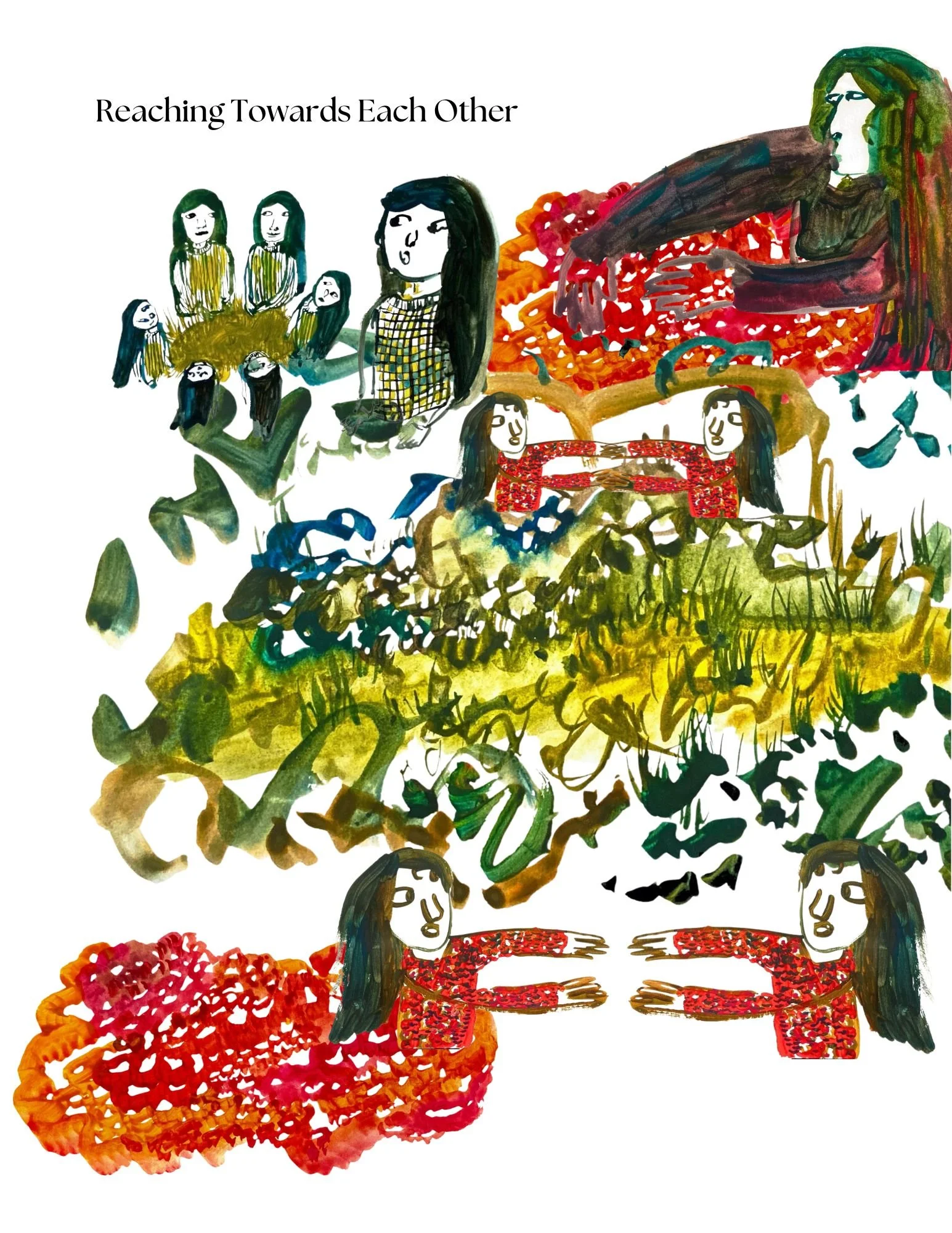
Trauma-informed practice is about reaching toward one another with care, humility, and awareness of lived experience. It emphasizes listening, shared decision-making, and culturally defined safety, while recognizing the impacts of stigma and intergenerational trauma. Practitioners walk alongside them, honoring strengths, autonomy, and connection.
A trauma-informed anthology: Global perspectives
By: Angeliki Kardamaki, Christen Kong, Gout Algloob Haj Elhassan, and Lalithashree Ganesh
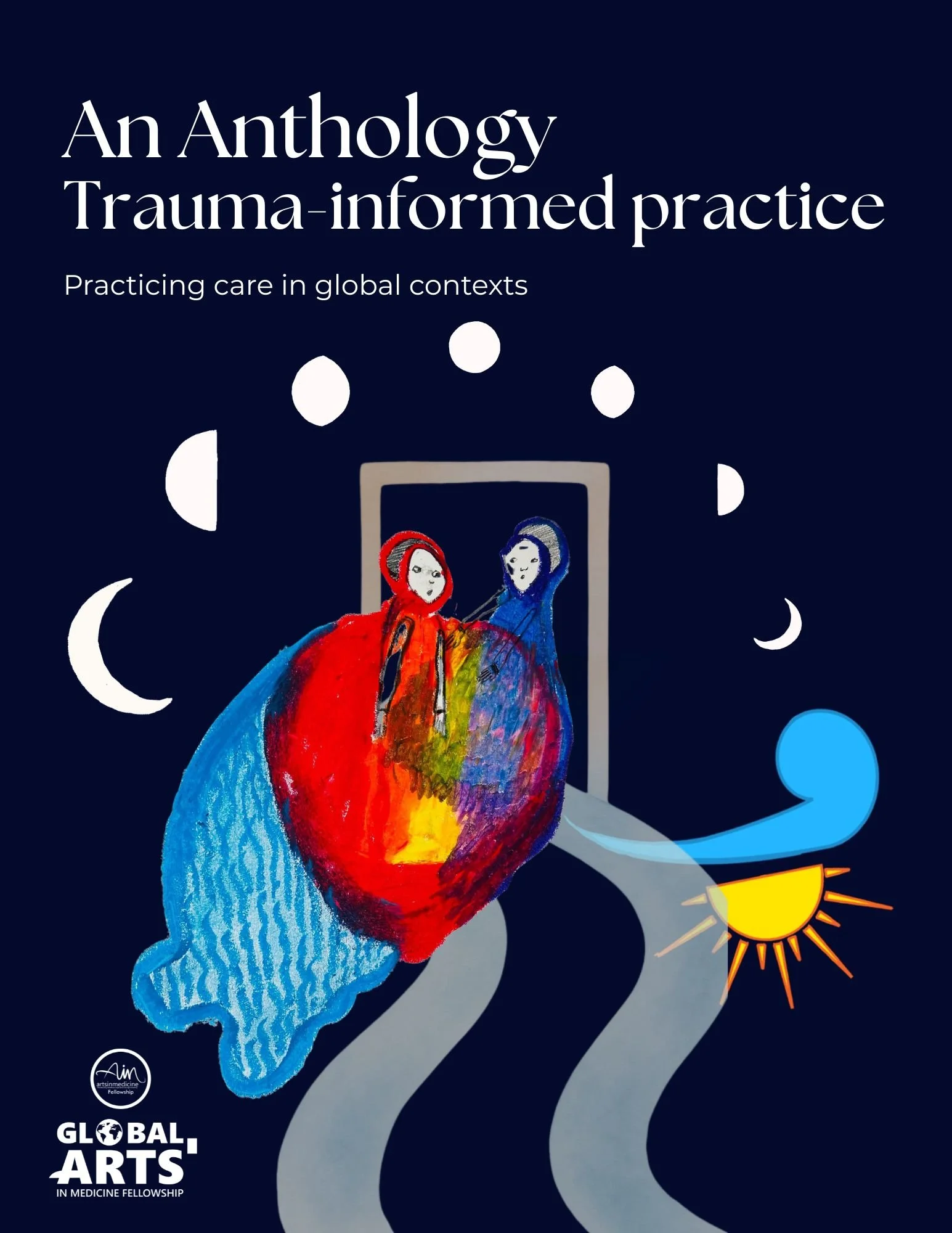
What does trauma-informed practice look, feel, sound, taste, and smell like? Across the world, arts and health practitioners are creatively weaving trauma-informed care into their daily work, yet no two expressions are the same. Each is informed by cultural context, intergenerational knowledge, and the movement of ideas across borders, producing deeply local yet globally connected approaches to healing. Click cover page to access the anthology.
In the ‘Arts in Medicine Fellowship’ program, practitioners from around the world come together to explore the role of the arts in public health. Within the fellowship are 12 thematic interest groups, one being the ‘Mental Health and Trauma Recovery’ group as a space for rich dialogue and collaboration.
This group, comprising a team including: Angeliki Kardamaki, Christen Kong, Gout Algloob Haj Elhassan, and Lalithashree Ganesh developed an anthology that brings together 40 multimedia artworks and reflections from practitioners across 16 countries. For a year, the team met weekly across 4 time zones, building a shared project grounded in a simple but powerful belief: art is a form of education that nurtures curiosity, creativity, and critical thinking; while making complex emotional experiences more accessible.
The anthology invited artist, practitioners, community members, and those with lived experiences of trauma to respond to the following questions:
What role do the arts play in trauma recovery within your community setting?
What are examples of culturally responsive or Indigenous practices that you have found effective in trauma-informed practice?
How does your cultural context shape the way trauma is understood, expressed, or addressed in your community?
The anthology features 35 contributions from photography and poetry to audio, video, and illustration. The collection offers a living resource for exploring trauma-informed practice through diverse cultural lenses. Guided by the role of the arts in trauma recovery, culturally responsive and indigenous practices, and the ways trauma is understood and expressed across communities, the anthology invites both reflection and dialogue.
The anthology is rooted in traditions of storytelling, ritual, and ceremony. The project centers “knowledge sharers”, who offer their lived experiences with courage and care, alongside “artful responders”, who engage through their own creative practices. Together, they create a layered conversation where art responds to art, deepening connection and understanding. Throughout the anthology, reflective prompts encourage readers to slow down, engage their senses, and become active participants in the experience.
This cross-border anthology is more than a collection, it is an invitation. To listen, to feel, to question, and to imagine new possibilities for healing through the arts.
Contact to learn more: art.medicine.fellowship@gmail.com
art responding to art
What does trauma-informed practice sound like?
Seeking answers beyond clinical frameworks, this sonic journey explores how collective care lives in the textures of everyday life. To create it, project curators from Canada, India, Sudan and Egypt recorded raw environmental sounds, voices, and songs from across their worlds. In the Netherlands, Angeliki Kardamaki and composer Yannis Patoukas let these materials spark their imagination, weaving them into a composition.
This soundscape embodies the anthology’s core methodology: the artful responder, where creators answer shared inquiries through creative practice. Paired with imagery from the publication, it is an invitation to listen, feel, and imagine new pathways for healing.
Symbols explained (00:00 - 00:30)
Angeliki: My choice of a door is inspired by a painting I saw on the Hubble Space Telescope’s official website. The artist, Shigeru Nokura, artistically repurposes a photograph taken from a satellite. I hope more people open doors for others, and that we find ourselves in the right rooms. And if those rooms are not there yet, let us imagine and create them.
Christen: My drawing emerged from a personal journey into art therapy. A pivotal learning during this time in my life was realizing the importance of showing self-compassion. The image depicts two heart figures consoling each other. Our hearts are not only meant to be shared with others, but with ourselves too.
Lalitha: Drawing the different phases of the ever-changing moon was a suggestion by my sister, Meenakshi, while I was brainstorming nature-based metaphors that could depict the essence of trauma-informed practice. Trauma work, whether with ourselves or with the people we work alongside, often takes time and moves through many changes, realizations, meaning-making, learning, unlearning, and relearning. Although parts of the moon remain hidden during certain phases, transformation and healing continue to happen behind the scenes.
Gout: The sun and the cloud symbolize the semicolon, inspired by the Semicolon Project by Amy Bleuel (2013), which represents resilience, hope, and the decision to continue living despite the struggles we face.
Audio soundscape by: Angeliki Kardamaki and Yannis Patoukas
Video by: Christen Kong
Audio sound contributors Angeliki Kardamaki (Netherlands), Christen Kong (Canada) Gout Algloob Haj Elhassan (Sudan) and Lalithashree Ganesh (India)
Visual contributors by Dr. Alicia Tetteh (United States of America), Peichi Waite (United States of America), Molly W. Schenck (United States of America), Sharon Attipoe-Dorcoo (United States of America), Dr. Devin Nikki Thomas (United States of America), Jenny McCloskey (United States of America), Gangji RR (Tanzania), Jasmine Kaur Sidhu (Canada), Vivian Chan (Canada), Felix Kwong (Canada), Christen Kong (Canada), Sarah N Ahmad (Canada), Sujata Setia (India), Dr. Rashmi Patil (India), Rashmi R (India), Shilka Agarwal (India), Lalithashree Ganesh (India), Dr. Vaidehi Chilwarwar (India), Bhargavi Raman (India), Nitya Chhetri (Nepal), Solape Adetutu Adeyemi (Nigeria), Oluwabukunmi Olukitibi (Nigeria), Hairat Bukola Yusuf (Nigeria), Bee Arogundade (Nigeria), Dr. Khadijah B. Ayoade-Suleiman (Nigeria), Adebayo Esther (Nigeria), Ijolomo Dance Company (Nigeria), Gout Algloob Haj Elhassan (Sudan), Dora Grivopoulou (Greece), Yimeng Zhang (China), Ramón Uboñe Gaba Caiga (Ecuador), Angeliki Kardamaki (Greece/The Netherlands), Sjafril (Indonesia), James Mellor (United Kingdom), Amira Fayyad (Egypt), Fatima Hashim Esawi Abdallha (Saudi Arabia)
What does trauma-informed practice feels, look, taste, sound, and smell like?
A warm hug, a blanket, a comforting and cosy cloud
A safe space, safe container, and meaningful connection
Inclusion, compassion, humility, and attentive care
A pendulation between past and present
Settling in the body and reconnecting with the senses
Relief, comfort, and being welcomed while choosing how to participate
A deep breath, an evening breeze after a long hot day, or swimming in warm water where you can stand
A vast ocean, morning mist, rustling leaves, jasmine flowers, and warm soup on a cold day
Comfort food made by one’s mother and gentle rubs when feeling unwell
Revisiting rebirth and being in process
Partners in health and collective connection
“💥Boom”