“Arts is a health behaviour” is a series co-written by Access Alliance Multicultural Health and Community Services practitioners and partners, imagining the healthcare and settlement sectors as sites for arts engagement. This series shares evidence and stories about how arts participation can improve the social determinants of health among newcomer individuals and communities.
“Article 27 Human Rights, everyone has the right to participate in cultural life and benefit from arts. ”
Why does it matter? Public health has long focused on behaviours that improve our health and well-being, including many we can quantify: physical activity, diet, sleep, avoiding harmful substances, and stress management. What if arts engagement is also another health behaviour?
The evidence For centuries, people around the world have used the arts in times of crisis, celebration, ceremony, and ritual. In 2019, the World Health Organization (WHO) published a landmark scoping review that synthesized thousands of studies demonstrating the benefits of arts engagement for human health and well-being across the lifespan. Canadian Indigenous drumming circles are well known not only for transmitting cultural knowledge but also for providing a space for social cohesion, healing, and mutual support. This evidence is no longer marginal; participation in the arts promotes mental health, prevents illness, helps manage diseases, and improves social connections. Still, art remains on the fringes of healthcare and settlement, and is partially recognized as a health behaviour.
Newcomer, arts, and health For newcomer communities, leveraging the arts for integration is increasing in focus. The Toronto Arts Council (TAC), in partnership with CERC in Migration and Integration released a report that emphasizes the arts as an immensely effective supportive factor for immigrant integration. Increasingly, mental health has become a focal point for healthcare and settlement agencies. During this surge, COVID-19 hit the globe from 2020 to 2023, intensifying mental health crisis experiences globally and locally.
Arts IS a health behaviour This series aims to inspire emerging and current healthcare practitioners, settlement workers, and those intrigued by the intersections of art in health to imagine creative care systems that respond to the evolving needs of our population. The arts are also deeply rooted in the Universal Declaration of Human Rights. Article 27 affirms that everyone has the right to participate in cultural life and the arts freely, and to share in their many benefits. When we begin from this perspective, arts access is essential to how we envision Canadian healthcare and settlement to enhance population well-being.
Community arts in focus: Evidence of community arts impact on newcomer social and mental wellness. Read article By Esther-Joelle Asare & Andrea Charise
“Imagine a world where creativity is prescribed alongside medicine.What if you received care from an artist as part of your care team?”
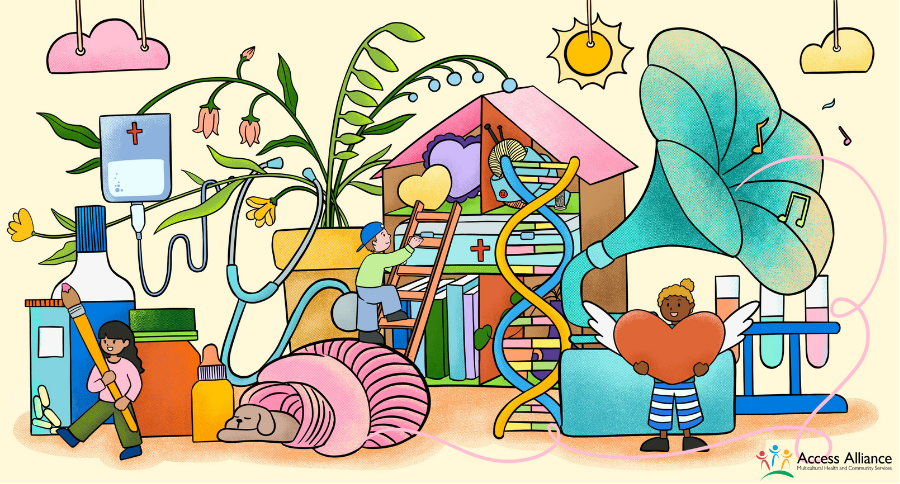
What if your healthcare team included an artist? Read article By Christen Kong
“For newcomers to Canada, creativity isn’t just a pastime, it can be a lifeline.Community arts practices are modern forms of humanity’s oldest collective expressions”
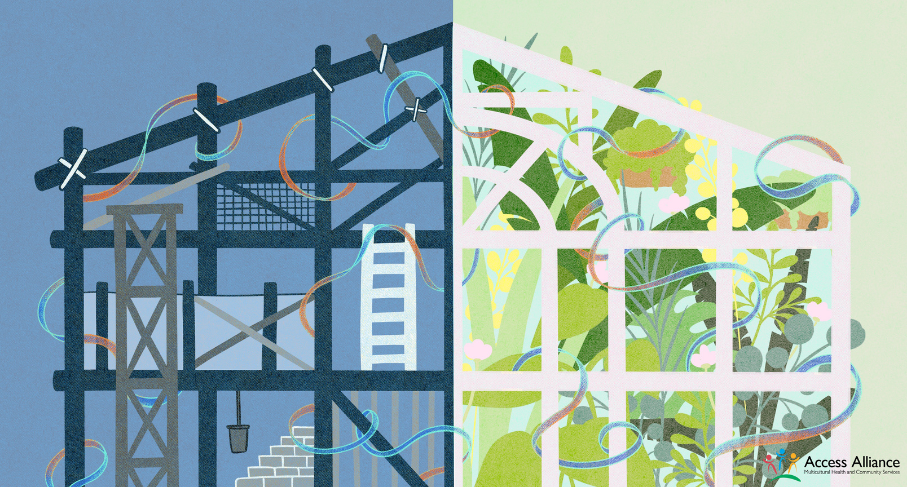
Art is health infrastructure: Rethinking gender-based violence responses for newcomer women. Read article By Jasmine Sidhu
“Arts can be an essential source to prevent and address family violence.Arts engagement as a health behaviour requires structural commitment”
“Togetherness is inviting others to walk side by side. Both newcomer participants and practitioners experience multi-layered barriers to healthcare.”
What if you received care from an artist as part of your care team? Read article By Lana Cho
References
Conklin, A., & Humphries, K. (2019, October 15). Drumming circles play unique role in Indigenous women’s heart health. Providence Health Care – The Daily Scan. https://thedailyscan.providencehealthcare.org/2019/10/drumming-circles-play-unique-role-in-indigenous-womens-heart-research/
Fancourt, D., & Finn, S. (2019). What is the evidence on the role of the arts in improving health and well‑being? A scoping review (Health Evidence Network synthesis report 67). World Health Organization, Regional Office for Europe. https://iris.who.int/handle/10665/329834
Singer, C. R. (2024, March 27). Canada sees highest annual population growth rate since 1957. Canada Immigration Services and Free Online Evaluation. https://immigration.ca/canada-sees-highest-annual-population-growth-rate-since-1957 (Canada Immigration Services)
Molho, J, Newoman, S, Tzatzanis, T. . (2025). *Fostering integration through the arts: Learning from Toronto Arts Council’s program for newcomers and refugees (FIT‑ART project)*. Toronto Arts Council. https://torontoartscouncil.org/wp-content/uploads/sites/2/2025/05/FIT-REPORT_DIGITAL_spread-1.pdf
“When health care respects people’s identities, experiences, and values, they are more likely to take action. Community artists help humanize both health care and settlement experiences.”
Beyond attachment: The role of community artists in newcomer primary care. Read article By Christen Kong